The majority of Earthquakes in Hawaii are centered in and around "The Big Island", Hawaii and are mainly the result of the volcanic activity of the Kilauea Crater and Mauna Loa Volcanos. Earthquakes are less frequent on the other isles. You can check out
the latest volcanic activity at Kilauea on our Hawaiian Volcanos Activity Page.
Current Reported Watches, Warnings and Advisiories for Oahu's Eastern Windward Shores
Local & Regional Weather Statements, Watches And Warnings
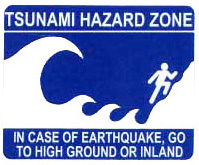
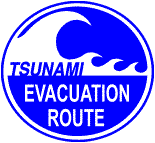
Tsunami (soo-NAH-mee): a Japanese word that means harbor wave; a sea
wave of local or distant origin that results from large-scale seafloor
displacements associated with large earthquakes, major submarine slides,
or exploding volcanic islands. Typically generated by seismic or volcanic
activity or by underwater landslides, a tsunami consists of a series of
high-energy waves that radiate outward like pond ripples from the area in
which the generating event occurred.
Not all earthquakes produce tsunamis. To generate a tsunami, an earthquake
must occur underneath or near the ocean, be very large (approximately Richter
magnitude 7 or greater), and create vertical movement of the sea floor. However,
recent studies regarding the potential for a great Cascadia Subduction zone
earthquake off the Washington, Oregon, and Northern California coastlines
indicate the local tsunami waves may reach nearby coastal communities within
minutes of the earthquake thereby giving little or no time to issue
warnings.
How will I know if a Tsunami is coming?
The West Coast/Alaska Tsunami Warning Center (WC/ATWC) is responsible for
tsunami warnings for California, Oregon, Washington, British Columbia and
Alaska.
The Pacific Tsunami Warning Center (PTWC) provides warnings to
international authorities, Hawaii, and U.S. Territories within the Pacific
Basin.
The WC/ATWC and PTWC may issue the following bulletins:
Information: A message with information about an earthquake
that is not expected to generate a tsunami.
Advisory: An earthquake has occurred in the Pacific Basin, which
might generate a tsunami.
Watch: A tsunami was or may have been generated, but is at
least two hours travel time to the area in Watch status.
Warning: A tsunami was, or may have been generated, which could cause
damage; therefore, people in the warned area are strongly advised to evacuate.
A warning siren may sound.
Seawater may recede quickly.
The ground may shake, indicating an earthquake has occurred.
Your NOAA Tone Alert radio issues a warning that a tsunami may be headed to your area.
Kãne‘ohe and Kãne‘ohe Bay with the Koolau Mountains as backdrop - Windward - Oahu, Hawaii
Member of the:
Pepper Ridge North Valley Random Weather Facts
METAR
An Acroymn for METeorological Aerodrome Report. The reports are primarly collected by equipment such as Automated Surface Observing Systems (ASOS). It is the primary weather observation code used in the United States to satisfy requirements for reporting surface meteorological data. Minimum reporting requirements includes wind, visibility, runway visual range, present weather, sky condition, temperature, dew point, and altimeter setting.


 New Feature




 Night time, Dry, Clear skies